
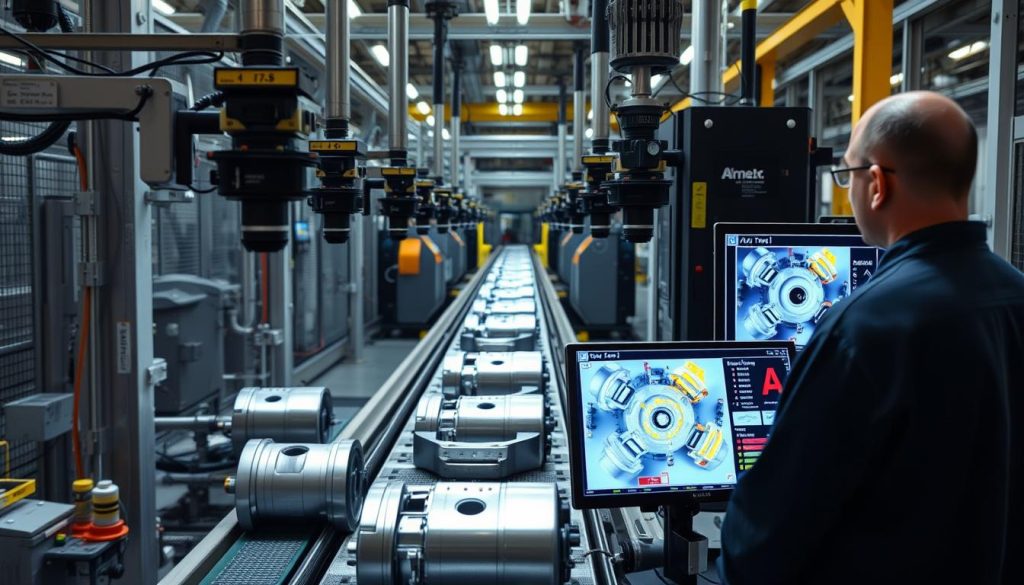
The path to achieving manufacturing excellence in the 21st century is defined by two key elements: speed and precision. As industries embrace technologies like robotics, IoT sensors, and cloud computing, the traditional reliance on human eyes for quality control has become the single largest point of vulnerability and inefficiency. Today, the world’s most advanced manufacturers are adopting Visual Inspection systems powered by Artificial Intelligence (AI) to ensure defect detection is not just accurate, but instantaneous and integrated with the entire digital factory ecosystem. To understand how advanced computer vision solutions are being deployed to secure 100% quality assurance and fuel next-generation manufacturing processes, explore the expert automated solutions provided by Opsio Cloud via our dedicated guide to Visual Inspection.
The implementation of Automated Visual Inspection (AVI) represents a permanent shift toward autonomous quality. It resolves the classic manufacturing dilemma: how to increase production velocity without sacrificing quality integrity. For organizations committed to the vision of a truly smart, adaptive factory, leveraging deep learning and edge computing expertise from specialists like Opsio Cloud is the most effective way to secure a competitive advantage built on verifiable, reliable quality.
Section 1: The Bottleneck of Subjectivity and Scale
For centuries, the human eye and brain served as the gold standard for quality control (QC). However, modern manufacturing realities have exposed the inherent flaws of this approach:
- Inconsistency and Bias: Human judgment varies. Factors like lighting, shift duration, personal interpretation of standards, and simple distraction introduce inevitable inconsistency into the quality process. This variation translates directly into unpredictable product performance for the end customer.
- The Speed Barrier: Many high-throughput lines (e.g., packaging, electronics, stamping) operate at speeds far exceeding the human visual processing limit. This forces companies to rely on statistical sampling—checking only a fraction of products—leaving the majority of items unchecked and exposed to latent defects.
- Complexity of Micro-Defects: Modern components, such as semiconductors and precision mechanical parts, require detecting flaws at the micron level—a task often impossible or extremely time-consuming for humans, even with magnification.
By migrating to automated Visual Inspection, manufacturers are effectively transferring quality responsibility from fallible human observation to tireless, objective, and data-driven computational systems.
Section 2: AI’s Role in Defining “Perfect” Quality
Modern AVI systems do not just execute rules; they learn and define quality using advanced machine learning, setting them apart from legacy rule-based machine vision.
A. Deep Learning for Complex Faults
Legacy vision systems relied on hard-coded parameters (e.g., “if pixel variation exceeds X, it’s a defect”). Deep learning models, particularly CNNs, are different. They are fed thousands of examples of both good and defective parts, allowing them to:
- Handle Variance: Accurately classify acceptable variations in texture, color, and finish that would confuse a simple rule-based system.
- Identify Novel Defects: Detect previously unseen or subtle anomaly patterns that signal a problem, even if the model wasn’t explicitly trained for that exact type of flaw.
This sophisticated pattern recognition enables the system to maintain accuracy even as materials and lighting conditions fluctuate on the factory floor.
B. The Power of Edge Integration
For real-time quality decisions, the AI processing cannot afford network latency. AVI architecture, implemented by experts like Opsio Cloud, leverages Edge Computing:
- Local Inference: High-performance, dedicated computing hardware runs the trained AI model directly on the production line, processing camera data and making decisions in milliseconds.
- Cloud-Powered Training: The central cloud is reserved for intensive tasks—managing the data lake, retraining the AI model with new defect examples, and deploying updated, optimized models back to the Edge fleet globally.
This distributed architecture ensures maximum speed, minimal downtime, and continuous model improvement across all manufacturing locations.
Section 3: The Economic Impact: From Cost Center to Strategic Asset
Automated Visual Inspection delivers a multifaceted return on investment (ROI) that extends far beyond labor savings:
- Guaranteed Quality Metrics: By providing 100% inspection with near-perfect consistency, AVI ensures that quality is a predictable engineering input, rather than a variable human output. This stability is crucial for certifying parts in supply chains (e.g., Tier 1 automotive suppliers).
- Optimized Resource Utilization: The immediate detection of defects minimizes the amount of material, energy, and labor wasted on faulty products. Detecting a flaw at Step 1 saves the cost of adding Value at Steps 2 through 10, resulting in significant savings on raw materials and reduced scrap disposal costs.
- Accelerated Innovation and Agility: When quality assurance is automated and reliable, manufacturing teams gain confidence and agility. They can more quickly test new product designs, adjust material inputs, and increase line speed, knowing the quality system will instantly flag any emerging issues. This shortens the feedback loop between design, production, and QA.
- Audit-Ready Traceability: Every inspection is recorded digitally, providing a complete, non-repudiable audit trail for every single unit produced. This capability is paramount for regulatory compliance and defending against liability claims, providing critical data that manual systems cannot match.
Section 4: Choosing the Right Partner for Autonomous Quality
The successful adoption of Automated Visual Inspection hinges on selecting a partner with expertise that spans both industrial control systems and enterprise-grade AI deployment.
Opsio Cloud provides end-to-end management for the autonomous quality journey:
- Process Audit and Data Strategy: We begin by analyzing your current production process and identifying the highest-impact inspection points, then design the optimal strategy for data capture and model training.
- Model Robustness and Deployment: We ensure the AI model is not only highly accurate but also resilient to real-world industrial noise, deploying it efficiently onto ruggedized Edge hardware that integrates seamlessly with your existing MES infrastructure.
- Governance and Scalability: Our managed service includes continuous model monitoring, performance tuning, and the cloud governance necessary to manage quality data securely across multiple factory floors, turning local inspection data into global operational intelligence.
By partnering with Opsio Cloud, you secure not just an inspection system, but a digital quality platform engineered for the future of manufacturing excellence.